Image Pair Dataset of Before/After Defect Occurrence
– Overview
This dataset was created for the purpose of automatic scratch inspection by image processing. It consists of ideal-image-pair of before/after defect occurrence (i.e., image pairs in which only defect regions are different and the others are almost completely the same). The model can generate highly realistic normal image (the image before defect occurrence) from the image after defect occurrence by using this dataset. And, the model can detect only defect regions by simply difference of these two images.
When you use this dataset in publications such as conference papers or journal articles, please cite the following URL or reference.
URL:http://isl.sist.chukyo-u.ac.jp/archives/before_after_occur
<Reference>
Hiroki Kobayashi, Ryo Miyoshi, Manabu Hashimoto, Scratch Detection based on Image Reconstruction using Ideal-Image-Pair Dataset of Just Before/After Defect Occurrence, International Workshop on Advanced Image Technology 2021 (IWAIT2021), PSI-44, online conference, 2021/01/05.
– How to collect data
This dataset was obtained using original imaging equipment and methods.
The appearance of the imaging equipment is shown in the image below. To prevent disturbance from external lighting, images were taken in an enclosed space of 60.0 cm×60.0 cm×60.0 cm with lighting placed above. And, image pairs of before/after defect occurrence were obtained using the following imaging method:
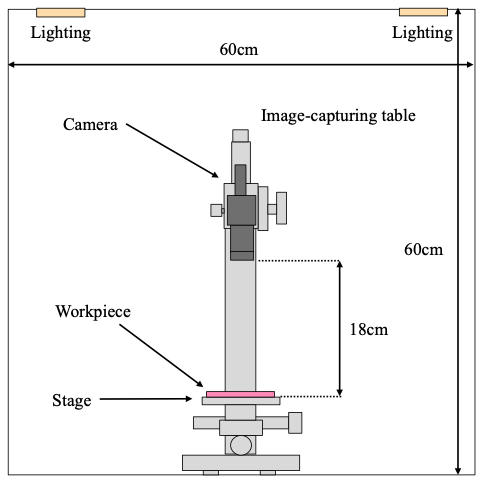
1.An unscratched workpiece is placed on the stage and the image before defect occurrence is obtained.
2.A scratch pattern is created by placing a 0.1 mm diameter wire on the workpiece.(To prevent the risk of the workpiece changing position.)
3.A scratched workpiece obtained in 2 is captured and the image after defect occurrence is obtained.
4.An image pair of 1 and 3 is defined as a pair of images before/after defect occurrence.
– Released Data
This dataset is made publicly available by processing images taken using the above method(width, height, channel)=(3264, 2448, 3) into grayscale images (width, height, channel)=(512, 512, 1). The processing procedure is as follows:
1.Convert from RGB to YUV color space and extract only the Y component.
(3264x2448x3=>3264x2448x1)
2. Resize using Lanczos4. (3264x2448x1=>816x612x1)
3. Crop the image so that the scratch remains in the image after defect occurrence.
(816x612x1=>512x512x1)
■Hairline / Ordinary
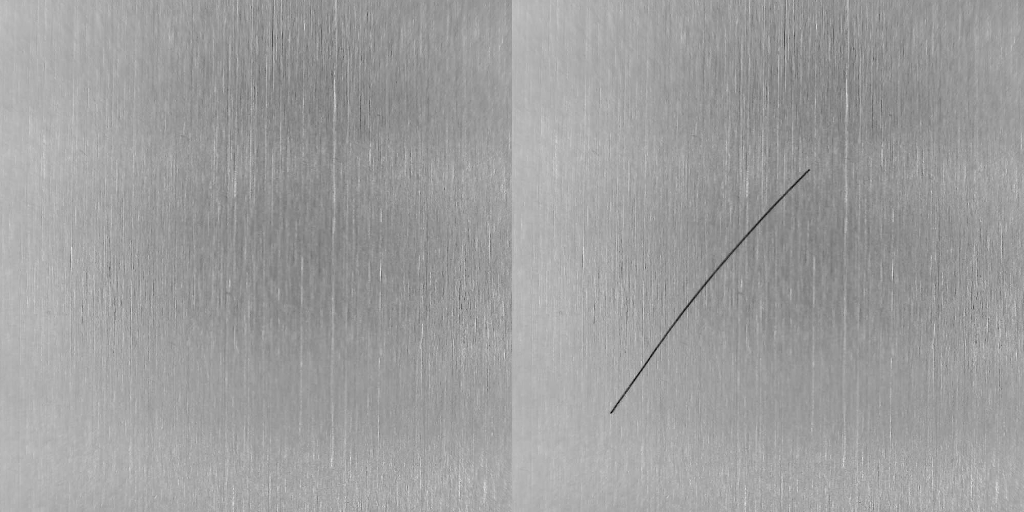 ■Template
■Training data (1800 image pairs)
■Test data (200 image pairs)
■Hairline / Bright
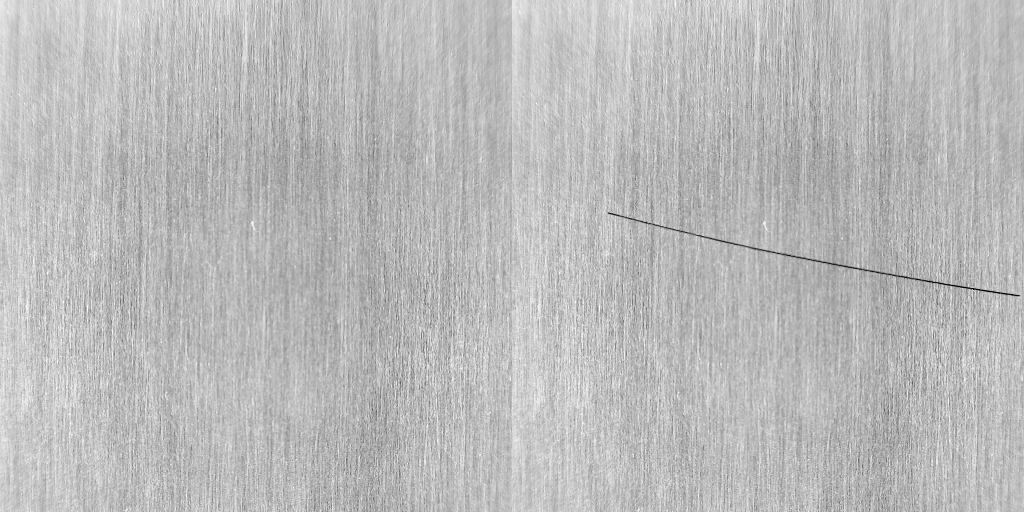 ■Template
■Test data (200 image pairs)
■Hairline / Dark
 ■Template
■Test data (200 image pairs)
■Plane / Bright
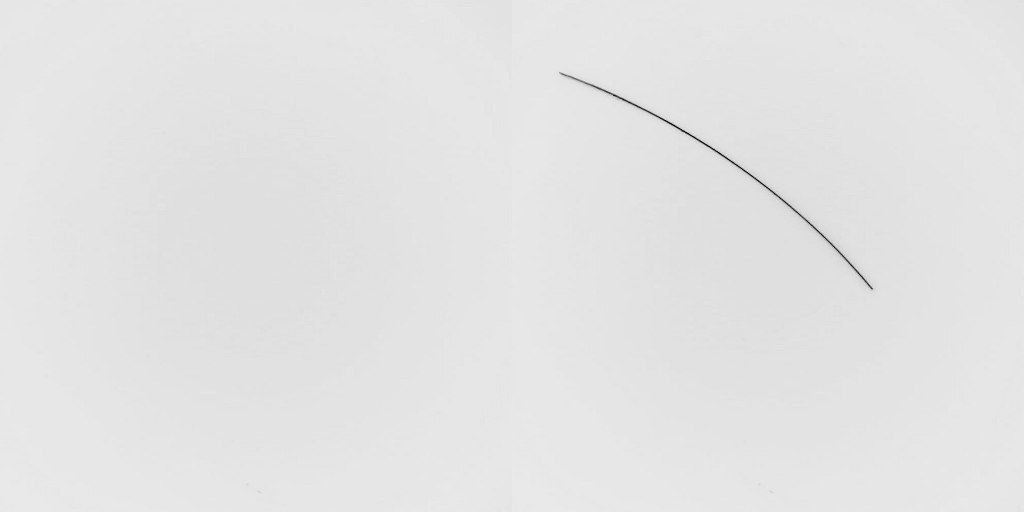 ■Template
■Training data (1800 image pairs)
■Test data (200 image pairs)
■Plain / Dark
 ■Template
■Test data (200 image pairs)
■Twill

■Template
■Test data (200 image pairs)